


Spis Treści
Thyroid Surgery, Thyroid Gland, Thyroid Diseases, and Surgical Treatment (Goiter)
What is the thyroid gland, and where is it located?
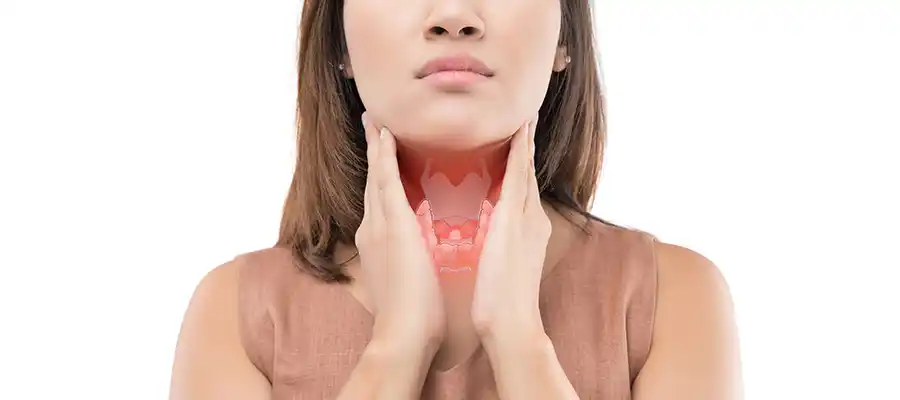
The thyroid gland derives its name from the Greek word for „shield” due to the shield-like shape of the largest cartilage in the larynx. Positioned just below and in front of the larynx, the thyroid gland consists of two parts — left and right — joined in the middle.
The gland is located beneath the muscles and skin of the neck and is one of the most vascularized organs in the body. It secretes hormones into the bloodstream, which regulate metabolism across all body tissues. These hormones are essential for life and play a critical role in metabolic functions.
How is the thyroid gland’s function assessed?
The best indicator of thyroid function is the TSH hormone secreted by the pituitary gland. TSH stimulates the thyroid gland to produce and release more hormones into the bloodstream. When the thyroid gland underfunctions, TSH levels rise. Conversely, if the thyroid overproduces hormones, TSH levels decrease.
Additionally, free T4 (FT4) and free T3 (FT3) levels are measured in specific cases to provide further insight into thyroid function. Your doctor may request these laboratory tests for a more comprehensive evaluation.
What happens when the thyroid gland underfunctions?
An underactive thyroid, or hypothyroidism, occurs when the gland fails to produce adequate hormones, resulting in slowed body functions. Symptoms include cold intolerance, fatigue, weight gain, hair loss, dry skin, constipation, and memory issues.
Common causes include autoimmune thyroiditis (Hashimoto’s thyroiditis), surgical removal of the thyroid, or radioactive iodine therapy. This condition is often lifelong, requiring patients to take hormone replacement therapy and remain under the care of an endocrinologist.
What happens when the thyroid gland overfunctions?
Overactivity of the thyroid gland, or hyperthyroidism, occurs when excessive hormones are produced, accelerating bodily functions. Symptoms include rapid heartbeat, palpitations, tremors, moist skin, irritability, and unexplained weight loss.
The most common cause of hyperthyroidism is Graves’ disease, which may also cause prominent, bulging eyes. Other causes include toxic nodular goiter and thyroiditis. Treatment options include:
- Oral medications to suppress hormone effects.
- Radioactive iodine therapy to reduce overactive thyroid tissue.
- Surgical removal of part or all of the thyroid gland.
What is a goiter?
An enlarged thyroid gland is referred to as a goiter. Causes include dietary iodine deficiency, certain goitrogenic foods like kale, or thyroid cancer. Diffuse goiter involves uniform enlargement, while multinodular goiter features multiple nodules within the gland.
Advances in ultrasound technology have revealed that many previously undetected diffuse goiters are, in fact, multinodular.
What is a thyroid nodule?
Thyroid nodules are growths or lumps within the thyroid gland caused by cell proliferation. They can be single (solitary) or multiple (multinodular) and classified as solid (non-fluid-filled) or cystic (fluid-filled).
Thyroid scans using radioactive materials further categorize nodules as „cold” (non-functioning) or „hot” (functioning). Most nodules are asymptomatic but may cause visible neck swelling or compressive symptoms if large.
About 5-10% of nodules are malignant. Factors increasing malignancy risk include childhood radiation exposure, male gender, advanced age, voice changes, or enlarged lymph nodes. Diagnostic approaches include physical exams, hormone tests, fine-needle aspiration biopsy, and imaging studies like ultrasound.
When is thyroid surgery necessary?
Surgical removal of part or all of the thyroid gland is recommended in the following cases:
- Confirmed or suspected thyroid cancer.
- Compression of the esophagus or windpipe, causing swallowing or breathing difficulties.
- Cosmetically concerning enlargement.
- Overactive thyroid causing hyperthyroidism.
What precautions are important during thyroid surgery?
The thyroid gland’s proximity to critical structures, such as the vocal cord nerves and parathyroid glands, requires meticulous surgical technique. Injury to the vocal cord nerves can result in significant voice changes. Damage to the parathyroid glands, responsible for calcium regulation, can cause temporary or permanent hypocalcemia.
Hypocalcemia symptoms include tingling around the mouth and extremities, cramps, and muscle spasms. Temporary calcium supplementation is usually sufficient, but persistent issues require additional treatment with calcium and vitamin D.
Modern Surgical Practices
Modern thyroid surgery aims to remove the affected gland entirely when necessary, especially in cases of cancer. Retaining residual tissue may complicate future monitoring and treatment, particularly radioactive iodine therapy or cancer recurrence evaluation.
When the problem is limited to one lobe of the thyroid, removing only that side may suffice. However, findings during or after surgery may necessitate complete removal. Properly executed surgery minimizes the risk of complications and enhances post-operative care, including monitoring for recurrence and facilitating additional therapies.